A person swiping an access card at the entrance does not necessarily mean that only one authorized person entered the building.
Someone can simply walk through the door behind them.
This seemingly harmless behavior is known as tailgating or piggybacking, and it is one of the most overlooked weaknesses in physical security. Unlike forced entry, there may be no damaged doors, broken locks, or obvious signs of intrusion. The access control system may even show a completely legitimate entry.
For businesses, the challenge is making sure that the person who is physically entering a secured area is actually the person authorized to be there.
That requires more than an access card. It involves the right combination of access control, physical security technology, surveillance, visitor management, and employee awareness.
Understanding Tailgating and Piggybacking
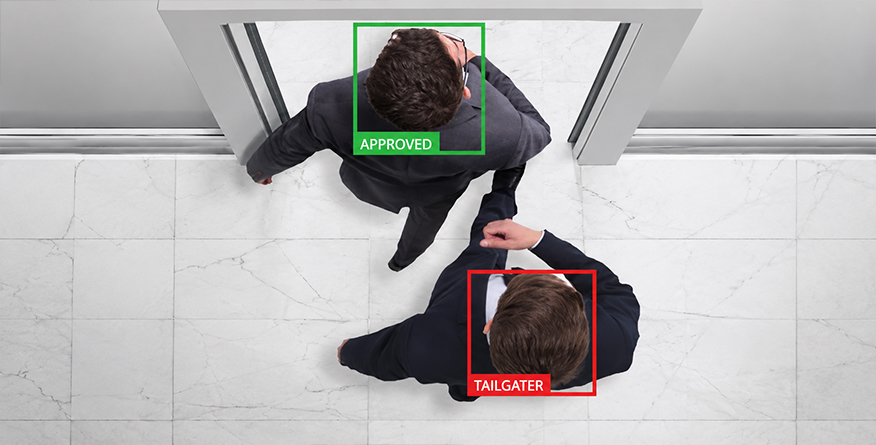
Tailgating happens when an unauthorized individual follows an authorized person through a controlled entrance without presenting their own credentials.
Imagine an employee arriving at an office. They use their access card, the door unlocks, and another person follows them inside before the door closes.
The access control system may record only the employee’s entry.
Piggybacking is similar, but with one important difference: the authorized person may knowingly allow the second person to enter. For example, an employee might hold the door open for someone who claims they forgot their badge.
In both situations, the security problem is the same. A person has entered a controlled area without independently proving that they are authorized to do so.
Why Tailgating Is More Than an Open Door Problem
Tailgating can be easy to dismiss because it often begins with an ordinary social interaction.
Someone holds the door open for a colleague. A visitor walks behind an employee. A contractor enters alongside a member of staff.
The problem is that once someone passes through a secured entrance, they may have access to areas that were never intended for them.
Depending on the facility, this could include offices, warehouses, equipment rooms, production areas, research facilities, or other restricted spaces.
The risk becomes particularly significant in organizations that handle valuable equipment, sensitive information, expensive inventory, or critical infrastructure.
An access control system can confirm that an authorized credential was used. It cannot always confirm that only the authorized individual passed through the doorway.
That is where additional security layers become important.
Access Control Is the Starting Point
A strong physical security strategy begins with controlling who is allowed through each entrance.
Businesses can use access cards, key fobs, mobile credentials, PINs, biometrics, or other authentication methods to restrict access to buildings and specific areas.
But access control should not be treated as a complete solution to tailgating.
Businesses should first determine which entrances require protection and what level of security each one needs. A main office entrance may have different requirements from a server room, warehouse, loading area, or restricted production zone.
Access permissions should also be regularly reviewed. Employees should only have access to the areas required for their responsibilities, while temporary workers and contractors should receive appropriately limited credentials.
This reduces the consequences if someone manages to enter behind another person.
Create a Physical Barrier Between Authentication and Entry
One of the most effective ways to address tailgating is to make it physically difficult for multiple people to pass through after a single authentication event.
This is where technologies such as turnstiles, speed gates, and mantrap systems can be useful.
A turnstile or speed gate is designed to allow controlled passage, making it more difficult for a second person to follow directly behind an authorized user.
A mantrap takes this concept further by creating an enclosed area between two doors. The second door remains locked until the required conditions are satisfied.
These systems can be particularly valuable in environments where unauthorized entry presents a significant risk, such as data centers, financial facilities, research environments, and critical infrastructure.
Not every business needs this level of control. The right solution depends on the risk associated with the facility.
Use Sensors to Detect More Than Just Door Opening
A traditional access control system knows when a credential has been presented and whether access was granted.
Physical security systems can go further by detecting what actually happens at the entrance.
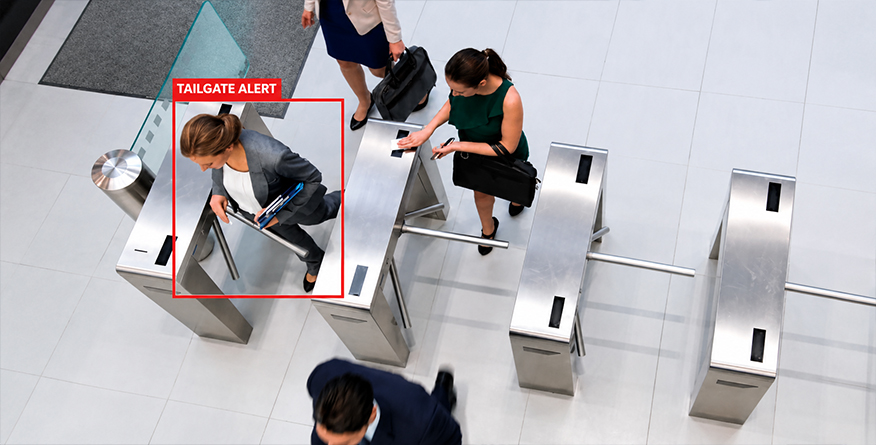
Anti-tailgating solutions can use technologies such as infrared sensors, people-counting systems, optical sensors, and other detection methods to determine whether multiple people have passed through an entrance following a single access event.
For example, an employee may present one valid credential, but the system detects two people entering.
That difference can generate an alert for security personnel to investigate.
This creates an important additional layer of protection: the system is not only asking whether the door was legitimately opened, but whether the resulting movement through the entrance was consistent with the authorization event.
CCTV Helps Verify What Access Control Cannot
Video surveillance is another important part of preventing and investigating tailgating.
An access control log might show that an employee entered a building at 9:15 AM. A nearby security camera can provide the missing context by showing exactly what happened at the entrance.
Was there one person?
Were there two?
Did someone follow immediately behind?
Was the second person carrying a visitor badge?
This makes CCTV particularly valuable when integrated with access control.
Instead of treating access records and video footage as separate sources of information, security teams can use them together to understand what actually occurred.
AI Can Help Identify Suspicious Entry
Modern video analytics can add another layer to entrance security.
Instead of relying entirely on security personnel to watch cameras, intelligent video systems can analyze activity around controlled areas and identify predefined events.
Depending on the system, this can include detecting multiple people moving through an entrance, movement in restricted areas, unusual activity, or individuals crossing defined boundaries.
The advantage is not simply having more cameras.
It is being able to turn camera footage into actionable security alerts.
For larger facilities with numerous entrances and cameras, this can make it much easier for security teams to focus their attention on events that actually require investigation.
Don’t Forget About Employees
Technology can reduce the opportunity for tailgating, but employee behavior remains a major part of the equation.
People naturally hold doors open for others. In a normal social situation, this is considered polite.
Inside a controlled facility, however, it can create a security vulnerability.
Employees should understand that asking someone to use their own access credential is not rude or unnecessary. It is part of maintaining the security of the workplace.
Security awareness training should therefore explain simple behaviors such as:
- Do not allow unknown individuals to follow through secured doors.
- Do not lend access cards or credentials to other people.
- Ask visitors to follow the proper check-in process.
- Report suspicious activity around entrances.
- Avoid assuming that someone is authorized simply because they appear to belong in the building.
The objective is not to make employees suspicious of everyone around them. It is to establish a consistent security culture where controlled access is treated seriously.
Visitor Management Closes Another Security Gap
Visitors can make tailgating more difficult to detect because they may legitimately enter alongside an employee.
A strong visitor management process helps businesses distinguish between employees, contractors, vendors, and visitors.
Visitors can be required to register at reception, verify their identity, receive temporary credentials, and remain within approved areas.
Temporary access credentials can also be configured to expire automatically or operate only during specific times.
This creates a clear distinction between someone who has been properly authorized to enter and someone who simply followed another person through the door.
Pay Attention to Secondary Entrances
The main entrance is usually the most visible and heavily controlled part of a facility.
But it is rarely the only way inside.
Side entrances, parking garages, loading areas, stairwell doors, employee entrances, and emergency exits can all create opportunities for unauthorized access.
Businesses should evaluate these areas as part of their overall physical security assessment.
A facility can have excellent security at its main entrance and still have a significant vulnerability through a poorly monitored side door.
Every entrance should have controls appropriate to its purpose and risk level.
Monitor Doors for Suspicious Activity
Tailgating is not the only unusual behavior that can occur around controlled entrances.
Security teams should also consider events such as doors being held open for unusually long periods, repeated denied access attempts, access outside normal operating hours, or credentials being used in unusual locations.
Door position sensors, access control logs, and security alarms can help identify these events.
When combined with CCTV, they give security personnel more information about what is happening around the facility.
This can turn isolated access events into a broader picture of suspicious activity.
Build Security in Layers
There is no single technology that can completely eliminate tailgating.
The most effective approach is to build multiple layers that work together.
Access control determines who is authorized.
Anti-tailgating sensors can identify unusual movement through controlled entrances.
CCTV provides visual verification.
Visitor management controls temporary access.
Security personnel can respond when something appears suspicious.
Employee awareness helps prevent the behavior from happening in the first place.
Each layer addresses a different part of the problem.
If one layer fails, another can still provide protection.
Choose Security Measures Based on Your Facility
The right approach to preventing tailgating depends heavily on the environment.
A small office with a few employees may only need controlled entrances, CCTV, visitor procedures, and employee awareness.
A large corporate facility with hundreds of employees may benefit from turnstiles, speed gates, people-counting technology, integrated surveillance, and centralized monitoring.
A high-security facility may require even stronger controls, such as biometric authentication and mantrap systems.
The goal is not to install every available security technology.
It is to identify where unauthorized access could cause the greatest damage and build appropriate controls around those areas.
Final Thoughts
Tailgating and piggybacking may begin with something as simple as holding a door open, but the security consequences can be much more serious.
Businesses can reduce the risk by combining strong access control with physical barriers, anti-tailgating detection, CCTV, visitor management, employee training, and appropriate monitoring.
The most important principle is straightforward: every person entering a secured area should have a valid reason and authorization to be there.
When technology and security procedures work together, businesses can make their entrances more than just controlled.