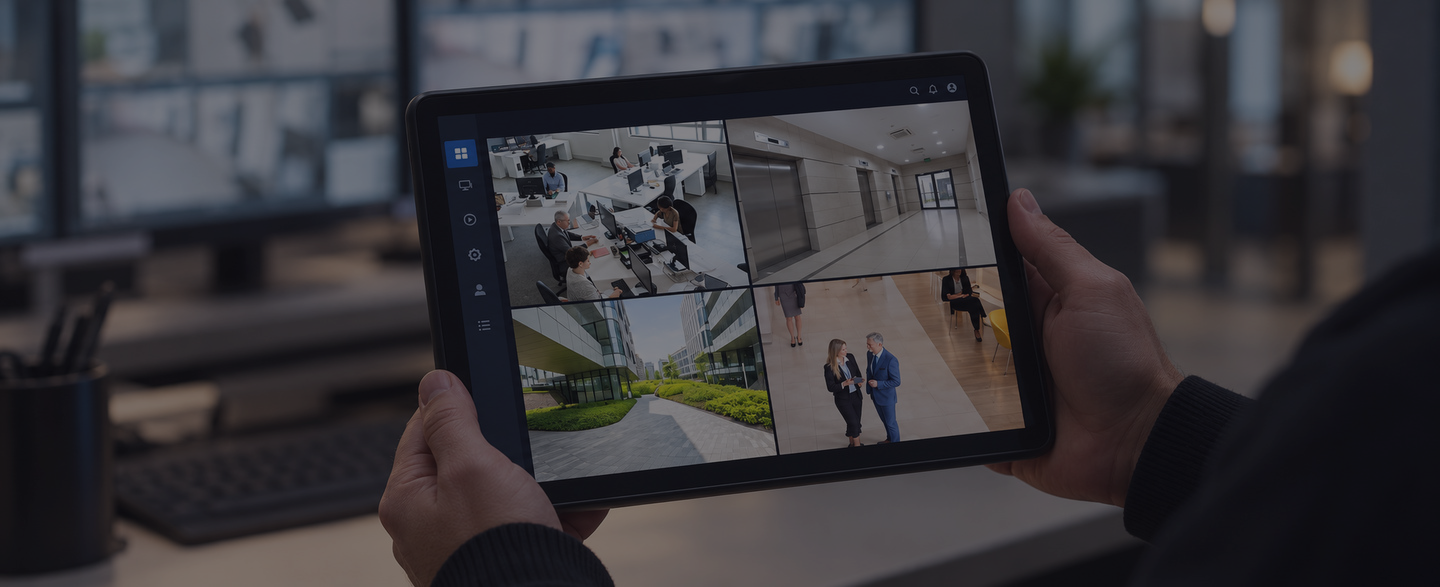
Public spaces such as municipal parks, vibrant urban plazas, and sprawling transit hubs serve as the vital connective tissue of our communities. They are designed to be open, accessible, and welcoming to all. However, for the property managers, transit authorities, and municipal leaders charged with overseeing them, this open-door nature presents a complex operational challenge: How do you protect thousands of daily visitors and safeguard multi-million-dollar infrastructure without transforming a welcoming environment into a restrictive fortress?
Maintaining high-level visibility and response readiness in wide-open, high-traffic spaces requires moving beyond isolated, legacy hardware. True security demands intelligent system integration.

The Core Challenges of Public Space Security
Unlike a commercial office building or a corporate campus, public spaces lack a defined perimeter. Security teams cannot simply place badge readers on every entrance or restrict the flow of people during standard business hours. Instead, they must contend with specific structural vulnerabilities:
The process is designed for maximum user convenience and high-throughput environments:
- Vast Footprints and Blind Spots: Parks and transit hubs span massive areas with complex layouts, landscaping, and architectural structures that can easily create dangerous visual blind spots.
- High-Volume, Transient Traffic: Hundreds or thousands of individuals pass through these hubs every hour, making it incredibly difficult to isolate anomalies or identify potential threats in real time
- Environmental Exposure: Security hardware deployed in plazas or outdoor transit platforms must withstand harsh weather conditions, fluctuating light levels, and the risk of physical vandalism.
- Inter-Agency Coordination: When an incident occurs, public safety officials, transit operators, and local law enforcement need immediate, actionable data to coordinate an effective response.
The Integrated Framework: Unifying Video, Audio, and Detection
Solving these challenges requires a shift from a reactive security model to a proactive, situational awareness framework. An integrated system unifies separate components into a single, cohesive ecosystem managed through a centralized dashboard.
1. Strategic Video Surveillance & Advanced Analytics
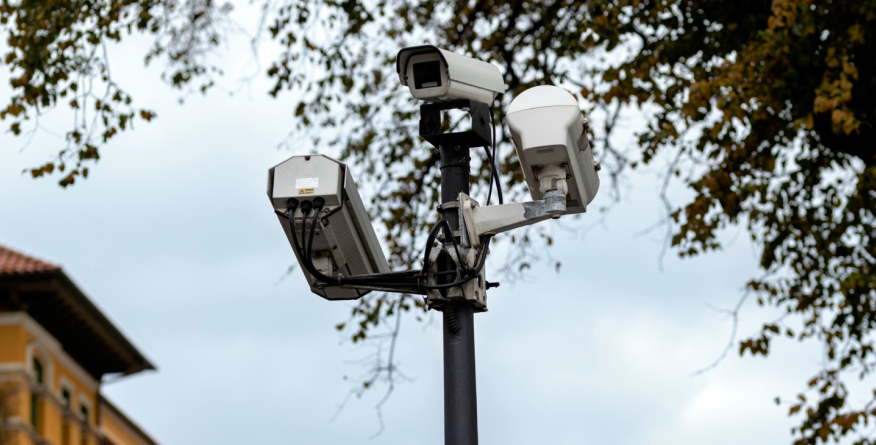
In a vast public plaza or transit terminal, a camera is only as valuable as the network backing it up. Modern surveillance relies on high-resolution IP cameras engineered for extreme environments. However, because human operators cannot effectively monitor dozens of live video feeds simultaneously, advanced video analytics are essential.
Integrated surveillance systems use edge computing and AI-driven analytics to establish virtual tripwires around restricted maintenance areas, track wrong-way pedestrian traffic in transit exits, and automatically flag unattended baggage. When an anomaly is detected, the system immediately pulls the relevant live feed to the forefront of the central operations center, transforming video from a historical record into a real-time tool.
2. Intelligent Audio and Public Address (PA) Integration
Communication is a vital asset during a security incident or a medical emergency. In many traditional setups, public address (PA) systems operate entirely separate from the security network.
By integrating high-performance PA systems with video surveillance, dispatchers gain the capability to issue targeted, zone-specific audio announcements. If video analytics detect a crowd forming dangerously close to a transit platform edge, or an individual entering a closed park zone after hours, operators can launch live or pre-recorded audio warnings to defuse the situation before sending physical patrols.
3. Early Threat Detection: Gunshot & Advanced Sensors
In high-density public venues, minutes and even seconds can save lives. Integrating automated gunshot detection systems into public space infrastructure eliminates the human delay inherent in reporting emergencies. These specialized acoustic sensors instantly recognize the distinct sound signature of a firearm discharge, triangulate the exact location within meters, and automatically execute a chain of pre-programmed actions:
- Alerting local emergency services with precise GPS coordinates.
- Orienting nearby PTZ (Pan-Tilt-Zoom) surveillance cameras toward the incident area.
- Locking down connected access points to protect adjacent facilities.
The Foundation: Structured Cabling for Uncompromising Reliability
The sophisticated software, high-definition cameras, and smart sensors that comprise an intelligent security platform all depend on a resilient physical foundation. In sprawling outdoor spaces and massive transit stations, your network infrastructure is just as critical as the edge devices themselves.
Structured cabling solutions designed for public spaces utilize weather-resistant, fiber-optic backbones and ruggedized network switches to transmit massive volumes of data across long distances without latency or degradation. Properly engineered cabling ensures that your system remains fully operational under peak loads, during extreme weather events, and through future hardware upgrades..
Engineering Confidence with Electro Specialty Systems
Securing a public space is not about purchasing the newest individual gadget or scattering more cameras across a plaza. It requires an intentional, engineered approach that looks at your entire operational footprint.
As a premier San Diego security integrator, ESS specializes in walking public sites, evaluating complex infrastructures, and designing custom-tailored systems that unify access control, video monitoring, intrusion protection, and audio communications into one smart, reliable platform. Backed by factory-trained technicians and 24/7/365 emergency support, we ensure that public spaces can fulfill their true purpose: remaining safe, open, and vibrant hubs for the community.