License Plate Recognition (LPR), also known as Automatic License Plate Recognition (ALPR), has become an important part of modern security systems. Instead of requiring security teams to manually review hours of video, LPR cameras can automatically detect license plates and turn vehicle activity into searchable information.
For a facility owner, however, choosing an LPR system involves more than asking which camera can read a license plate. The way the system is provided, where data is stored, who can access it, whether information can be shared, and how the technology fits into an organization’s existing security infrastructure can all have a major impact.
Flock Safety and Avigilon offer different approaches to LPR. Flock combines its cameras with a managed subscription service and a connected platform, while Avigilon offers dedicated LPR cameras that can be incorporated into an organization’s own security infrastructure, including on-premise deployments. Understanding those differences can help facility owners determine what type of LPR solution makes sense for their property.
What Is Automatic License Plate Recognition (ALPR)?
Automatic License Plate Recognition uses cameras and software to automatically identify and read vehicle license plates. Depending on the system, a captured record can include the plate number, state, vehicle image, date, time, camera location, and characteristics such as vehicle make, model, or color.
The main advantage over a conventional security camera is that this information becomes searchable. Instead of watching hours of footage to find a particular vehicle, an authorized operator can search for a plate or vehicle characteristics and quickly locate relevant detections.
For a facility, that can be useful when investigating theft, monitoring entrances and exits, identifying vehicles associated with an incident, managing parking, or creating alerts for vehicles of interest. ALPR technology itself is not new, what has changed is the scale and connectivity of modern systems. A single camera can provide information about one property, while a connected network can potentially provide vehicle sightings across multiple locations.
How Flock License Plate Recognition Works?
Flock Safety provides LPR as a managed service rather than simply selling a standalone camera. Its subscription model includes hardware, installation, software, connectivity, maintenance, and support, with pricing determined by factors such as the technology, number of sensors, software package, and size of the deployment.
For a facility owner, this means the technology is delivered as an ongoing service. Flock manages much of the infrastructure behind the cameras, while the customer uses the Flock platform to search vehicle information, receive alerts, and manage the system.
One of Flock’s defining features is its ability to connect participating deployments. Customers can choose to share LPR information with other authorized organizations through the platform. Flock says that sharing is optional, customer-controlled, and subject to access permissions and policies.
That can be valuable during an investigation. If a vehicle associated with an incident is captured at one location and later detected by another participating camera, those additional detections may provide investigators with useful information about the vehicle’s movements.
How Avigilon License Plate Recognition Works?
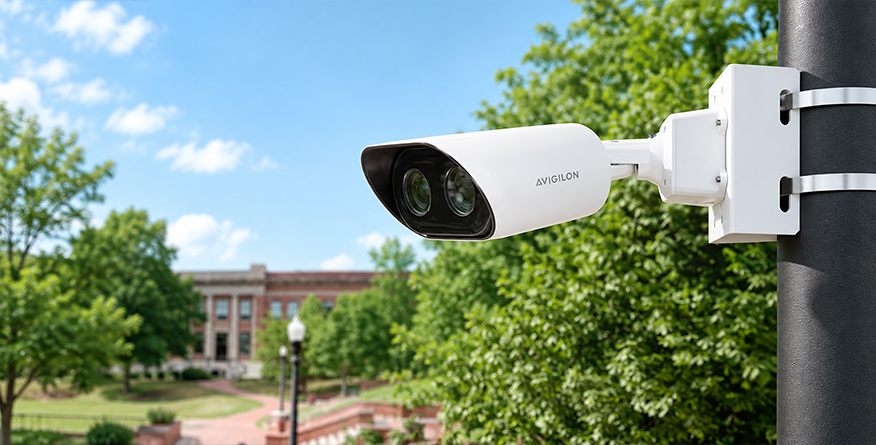
Avigilon takes a different approach by offering dedicated LPR hardware that can become part of a broader security system. Its L6A Enterprise LPR Camera is designed specifically for license plate capture and vehicle analysis and can capture information such as vehicle characteristics alongside the plate. Avigilon lists the L6A with up to 100 mph capture speed, 328-foot maximum daytime capture, and 250-foot maximum nighttime capture.
The L6A is designed to work with Avigilon Unity On-Premise, allowing organizations to incorporate LPR into their own video security environment. The camera can provide LPR detections through Avigilon’s video management ecosystem rather than requiring the customer to adopt a complete managed camera service.
Avigilon can also support broader collaboration. Its L6A materials state that customers can share scans across multiple sites and with law enforcement through VehicleManager Enterprise.
This is an important point: the difference between Flock and Avigilon is not that Flock can share LPR information while Avigilon cannot. Both can support sharing. The bigger distinction is the way the overall system is architected and operated.
Subscription vs. Ownership
One of the clearest differences is the business model.
Flock uses an all-inclusive subscription. The customer pays for an ongoing service that includes the hardware and much of the supporting infrastructure, including connectivity, storage, software updates, maintenance, installation, and support. Flock says this model is intended to eliminate the need for a large upfront investment in the complete system.
An Avigilon deployment can instead be built around purchased security hardware and an organization’s own security infrastructure. For facilities using Unity On-Premise, LPR becomes another component of the company’s broader video security system rather than an entirely separate managed service.
That creates a practical tradeoff. A subscription model can simplify deployment and reduce the amount of hardware and infrastructure the customer has to manage directly. An owned, on-premise approach can give an organization more direct control over the infrastructure it operates and how LPR fits into its existing security environment.
The right model depends on the facility. An organization starting from scratch may value a managed system, while a business with an established security network may prefer to integrate LPR into infrastructure it already manages.
The Difference in Data Storage and Control
Data management is one of the most important considerations when evaluating LPR because vehicle captures can reveal where a vehicle was seen and when.
Flock’s current policy states that customers own their LPR data and control who can access and share it. Flock says customer information is stored in AWS-based infrastructure, searches are logged, and LPR data is normally deleted on a rolling seven-day basis unless another retention period applies under customer policy or law.
That means it would be inaccurate to say that Flock simply owns or freely controls all customer data. The customer remains the stated owner, while Flock provides the technology and infrastructure through which the information is managed.
Avigilon’s Unity On-Premise approach provides a different architecture. The organization can operate its video management environment on-site, making LPR part of its own security infrastructure. Avigilon also supports cloud-connected capabilities where organizations choose to use them, so on-premise should not be interpreted as meaning a system can never connect to cloud services.
For a facility owner, the useful question is therefore not just “Who owns the data?” It is also “Where does the system operate, who administers it, and how much control do we want over the underlying security infrastructure?”

Flock’s Key Advantage
The connected network is one of the most distinctive features of Flock’s platform.
Imagine a vehicle involved in a burglary passes a Flock camera outside your facility. The system records the plate and vehicle information. If another participating organization has a Flock camera elsewhere, investigators may be able to find an additional detection of the same vehicle, subject to the applicable sharing permissions and policies.
That network effect can make a single LPR camera more useful because the system is not limited to what happened at one property. Flock promotes its platform as a way for participating organizations to share information and collaborate during investigations.
The same network capability is also central to the privacy debate surrounding Flock. The source material provided for this article notes that what distinguishes large Flock deployments is not simply license plate recognition, but the scale of the network and the ability to search information across different locations.
Can Avigilon LPR Data Be Shared?
Yes. Avigilon is not limited to a single isolated facility.
Avigilon’s L6A documentation says vehicle scans can be shared across multiple sites and with law enforcement through VehicleManager Enterprise. This means a company with several facilities can use LPR information across those locations, and organizations can share relevant information externally when their deployment is configured for it.
The important distinction is how the network is created. Flock’s platform is designed around a broader connected ecosystem of participating organizations, while Avigilon can provide multi-site sharing as part of an organization’s own security deployment.
For facility owners, this difference can matter when deciding how much they want their LPR system to rely on a provider’s wider network versus their own security infrastructure and policies.
Why Flock Has Faced Privacy and Data-Access Backlash?
The controversy around Flock is largely about the scale of searchable vehicle information and questions around access, sharing, and oversight.
A vehicle does not have to be connected to a crime to be captured by an LPR camera. When large numbers of cameras are deployed across a community, repeated detections can potentially reveal patterns in where a vehicle has traveled. The source material provided for this article highlights this as one of the central privacy concerns surrounding large-scale ALPR networks.
Those concerns became particularly visible in Mountain View, California. In January 2026, the city said an audit discovered that federal agencies had accessed data from a Mountain View Flock camera using a nationwide search setting that the city said had been enabled without its permission or knowledge. The city also said it found issues with a statewide search function and subsequently shut down the cameras.
Flock has disputed the broader idea that customers lose control of their data. Its current policies state that customers own their data, determine sharing settings, restrict access through authorized users, and have every search recorded for auditing.
The debate therefore goes beyond whether Flock is capable of sharing information. It is about how connected surveillance systems should be governed, how access should be controlled, and whether organizations have enough visibility into how their data and system capabilities are being used.
Security, Access Controls, and Auditability
Any LPR system should be evaluated as a complete security platform, not just as a camera.
Flock says its system uses role-based access controls, individual user accounts, multi-factor authentication, encryption, monitoring, and audit logging. Its current policy also states that every LPR query is recorded with information such as the user, time, purpose, and search criteria.
Avigilon provides security controls within its own ecosystem as well. Its L6A is designed for use with Unity On-Premise, and Avigilon highlights security features built into the camera and broader video management platform.
For facility owners, the important questions are consistent regardless of vendor: Who can search the system? Are searches logged? How long is information retained? How are user accounts protected? What happens when someone violates the organization’s security policy?
The provided source also highlights concerns about both technical vulnerabilities and inappropriate use by people with legitimate access, demonstrating why access controls and auditing are essential components of any LPR deployment.
What Should Facility Owners Consider Before Choosing an LPR System?
Start with the security objective. A facility may need LPR to secure entrances, investigate incidents, monitor parking areas, identify repeat vehicles, or support collaboration with law enforcement. Knowing the purpose makes it easier to determine how much connectivity, storage, and analytics the system actually requires.
Next, consider the operating model. Flock provides a managed subscription that bundles the cameras, software, connectivity, maintenance, storage, and support. An Avigilon system can instead be incorporated into an organization’s own security environment, including an on-premise deployment.
Data governance should also be part of the discussion. Facility owners should understand where LPR data is stored, how long it is retained, who can access it, whether it can be shared with other organizations, and what happens to the information and equipment when the service or deployment changes.
Finally, look at the total cost of ownership and integration requirements. Installation, networking, storage, licensing, maintenance, support, and integration with existing cameras or access-control systems can all affect the actual cost and usefulness of an LPR deployment.
Which LPR Approach Fits Your Facility?
Flock and Avigilon both offer LPR capabilities, but they approach deployment differently.
Flock is a managed subscription service built around a connected platform. The customer receives the cameras and supporting services as part of an ongoing relationship, while the platform can allow participating organizations to share LPR information under customer-controlled permissions.
Avigilon offers dedicated LPR hardware that can be integrated into an organization’s own video security infrastructure. Its L6A can operate with Unity On-Premise, while VehicleManager Enterprise can support sharing across sites and with law enforcement.
The decision is therefore less about which camera can simply “read plates” and more about how the facility wants its security operation to work. A managed, connected service may fit organizations looking for simplicity and network-based collaboration, while an on-premise Avigilon deployment may appeal to organizations that want LPR integrated into their own security infrastructure.
Conclusion
License Plate Recognition can provide valuable information for facilities looking to strengthen security around entrances, parking areas, and property perimeters. But the camera itself is only one part of the decision.
Flock and Avigilon offer different ways to deploy that technology. Flock combines LPR hardware with a managed subscription and connected platform, while Avigilon provides dedicated LPR cameras that can be integrated into an organization’s own security environment and support multi-site sharing when required.
For facility owners, the best starting point is to evaluate the complete system: ownership and service model, data storage, access controls, sharing requirements, infrastructure, integration, and long-term costs.
Electro Specialty Systems can help San Diego businesses evaluate their LPR requirements and determine how an Avigilon-based solution can fit into their broader video security strategy.