Vaping has become a persistent challenge for schools across the United States. Unlike traditional smoking, vaping can be difficult to notice. Devices are small, aerosols can dissipate quickly, and students may vape in places where staff cannot easily supervise them.
For school administrators, teachers, and security teams, stopping vaping requires more than simply enforcing a no-vaping policy. Schools need a comprehensive approach that combines education, student support, consistent policies, staff awareness, and technology that can detect vaping when and where it happens.
Vape detection systems such as the Avigilon HALO Smart Sensor can add another layer of protection by helping schools identify vaping activity in areas where traditional cameras and regular supervision may not be practical.
Here are some of the most effective ways schools can reduce vaping and create a safer learning environment.
Why Is Vaping So Difficult to Stop in Schools?
One of the biggest challenges with school vaping is that it is often difficult to detect until after an incident has already occurred.
Students may use vaping devices in bathrooms, locker rooms, stairwells, and other areas with limited adult supervision. Because these spaces are also privacy-sensitive, schools cannot simply rely on video surveillance everywhere.
Traditional approaches such as hallway supervision, disciplinary policies, and student reporting remain important, but they have limitations. Staff cannot be everywhere at once, and a student may be able to vape and leave an area before anyone notices.
This makes early detection and rapid response an important part of an effective school vaping prevention strategy.
7 Ways Schools Can Reduce Vaping
1. Establish Clear and Consistent Anti-Vaping Policies
Schools should have clear policies explaining that vaping and possession of vaping devices are not permitted on campus.
However, simply having a policy is not enough. Students should understand the rules, the reasons behind them, and the consequences of violating them.
Policies should also be applied consistently. When expectations and consequences are clear, students are less likely to view vaping restrictions as arbitrary.
At the same time, disciplinary policies should work alongside education and support. Students struggling with nicotine dependence may need access to appropriate counseling or cessation resources rather than relying exclusively on punishment.
2. Educate Students About the Risks of Vaping
Prevention starts with helping students understand what they are using and the potential consequences.
Schools can incorporate vaping education into health classes, assemblies, counseling programs, and other student activities. Discussions should address nicotine dependence, the potential health effects of vaping, and the risks associated with using unknown or illicit substances in vaping devices.
Education is particularly important for younger students who may encounter vaping through friends or social media before fully understanding its risks.
3. Involve Parents and Caregivers
A school’s anti-vaping efforts are stronger when parents and caregivers are involved.
Schools can provide parents with information about common vaping devices, signs that a student may be vaping, and resources for students who need help.
Parent meetings, newsletters, workshops, and educational resources can help extend prevention efforts beyond the school campus.
4. Identify Vaping Hotspots
Not every area of a campus presents the same level of risk.
Schools should review previous incidents, staff observations, and student reports to identify locations where vaping occurs most frequently. Common areas may include:
- School bathrooms
- Locker rooms
- Stairwells
- Parking areas
- Less frequently monitored hallways
- Other enclosed or isolated spaces
Identifying these locations allows schools to focus supervision, prevention efforts, and security resources where they are most needed.
5. Train Staff to Recognize and Respond to Vaping
Teachers, administrators, custodial teams, and security personnel can all play a role in identifying vaping activity.
Training can help staff recognize vaping devices, understand school policies, identify common locations where vaping occurs, and know how to respond when an incident is suspected.
But manual detection has an obvious limitation: staff cannot continuously monitor every location on campus.
That is where technology can complement existing security practices.
6. Use Vape Detection Technology in High-Risk Areas
Vape detectors provide schools with a way to monitor areas where cameras may not be appropriate and where staff cannot maintain constant supervision.
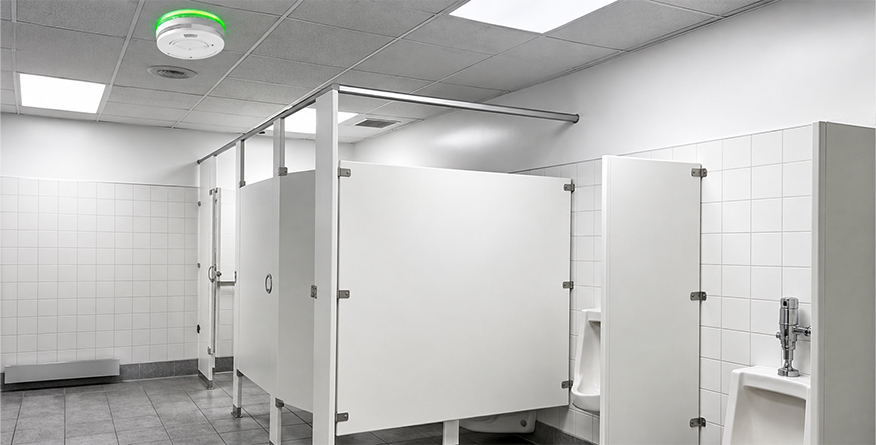
Installed in locations such as bathrooms and locker rooms, vape detection sensors can identify vaping activity and send alerts to designated personnel.
This gives staff an opportunity to respond while an incident is occurring rather than discovering it afterward.
7. Use Incident Data to Improve Prevention
Vape detection can provide more than an immediate alert.
When schools can identify where and when incidents are occurring, administrators can look for recurring patterns. For example, repeated incidents in a particular bathroom during a specific part of the school day may indicate that additional supervision or other preventive measures are needed.
Over time, this information can help schools make better decisions about staffing, sensor placement, student education, and other prevention efforts.
How Vape Detectors Help Schools Respond Faster
Vape detection technology is designed to complement, not replace, school staff and established policies.
A sensor can monitor an area continuously and alert designated personnel when vaping is detected. Staff can then investigate the incident and respond according to the school’s procedures.
This creates a more proactive approach.
Instead of relying entirely on someone seeing a student vape, schools can receive an alert when a potential vaping event occurs. That can be particularly valuable in bathrooms, locker rooms, and other areas where traditional video surveillance may not be suitable.
Why HALO Is a Good Fit for Schools
The Avigilon HALO Smart Sensor provides schools with an additional layer of detection and awareness without requiring video surveillance in privacy-sensitive areas.
HALO can detect vaping and smoking while also providing other environmental and safety monitoring capabilities. This allows schools to use one intelligent sensor for more than a single purpose.
Depending on the model and configuration, HALO can help schools monitor:
- Vaping and smoke
- Air quality conditions
- Environmental conditions
- Occupancy and people counts
- Other safety and security events
HALO can also integrate with existing security infrastructure, allowing alerts and information to become part of a school’s broader security response.
Monitor Areas Where Cameras Can’t Go
Bathrooms and locker rooms are among the most common locations where schools struggle to detect vaping.
Video surveillance is generally not appropriate in these privacy-sensitive spaces. HALO provides an alternative by monitoring environmental conditions and detecting vaping without requiring cameras inside those areas.
This allows schools to improve awareness while maintaining the privacy of students.
Receive Alerts When Vaping Is Detected
When HALO identifies a potential vaping event, designated personnel can receive an alert and follow the school’s response procedures.
Faster notification can help security teams investigate incidents sooner, identify recurring problem areas, and reinforce the school’s anti-vaping policy.
Go Beyond Vape Detection
Vaping may be the immediate concern, but schools face a wide range of safety and environmental challenges.
HALO is designed as an intelligent sensor rather than a single-purpose vape detector. Its capabilities can help schools monitor additional conditions and safety events, giving administrators more value from the same technology.
For schools looking to strengthen their overall security infrastructure, this can make HALO a useful addition to an existing security strategy.
Which HALO Solution Is Right for Your School?
Schools have different requirements depending on campus size, existing security infrastructure, and the areas they need to monitor.
Avigilon HALO 3C Smart Sensor
The HALO 3C is designed for schools looking for intelligent detection and environmental monitoring in areas such as bathrooms, locker rooms, and other high-risk locations.
Regular price: $1,495
With Current offer: $1,295 Only
Avigilon HALO 3C-PC Smart Sensor With People Counting
The HALO 3C-PC provides the capabilities of the HALO 3C while adding people-counting functionality.
This can be useful for schools that want additional occupancy and people-counting insights alongside vape and environmental detection.
Regular price: $1,795
Current offer: $1,595 Only
HALO Amplify Wireless Occupancy Sensor
The HALO Amplify is a wireless occupancy sensor designed to expand occupancy monitoring capabilities.
Regular price: $495
Current offer: $395 Only

How to Build a More Effective Anti-Vaping Strategy
There is no single solution that will eliminate vaping from a school campus overnight.
The most effective approach combines several layers of prevention and response.
Schools can:
- Set clear expectations through consistent anti-vaping policies.
- Educate students about the risks associated with vaping and nicotine.
- Support students who may be struggling with nicotine dependence.
- Work with parents to extend prevention efforts beyond school.
- Identify vaping hotspots using incident reports and staff observations.
- Train staff to recognize and respond to vaping.
- Deploy vape detection technology in areas that are difficult to monitor.
- Use incident information to identify patterns and improve prevention efforts.
The goal isn’t simply to catch students vaping. It is to create an environment where vaping is harder to hide, incidents can be addressed quickly, and students have access to the education and support they need.
Take a Proactive Approach to Vaping in Schools
Stopping vaping requires more than punishment after an incident occurs. Schools need prevention, education, student support, staff awareness, and the ability to identify incidents when they happen.
HALO can provide that additional layer of visibility in areas where traditional surveillance has limitations. By combining vape detection with broader environmental and safety monitoring, schools can strengthen their existing security strategy while protecting student privacy.
Ready to take a more proactive approach to vaping? Explore HALO solutions from Electro Specialty Systems and take advantage of the current savings.